
Fleet Desk Diaries is a story-based operating handbook built around one fictional company, one locked cast, and real fleet problems that operators recognize immediately. RedClay Site Services is fictional. The mechanics are not.
Some fleet problems are technical. Some are process problems. And some are the more dangerous kind: problems hidden inside numbers that look trustworthy.
That is what Fleet Desk Diaries is about.
This series follows one fictional company, RedClay Site Services, and one locked cast of people trying to keep a mixed-OEM fleet running while data, downtime, urgency, and local workarounds quietly fight each other in the background. Each article explores one real fleet problem through a story, then ends with a practical tool readers can adapt in their own operation.
So this is not transformation theater. No magic dashboard appears and fixes everything. No one delivers a grand speech and the fleet becomes wise. The point is simpler: show the problem, show why it happens, show what changed, and leave something useful behind.
Meet RedClay Site Services
RedClay Site Services is a fictional mid-sized contractor based in Charlotte, North Carolina, operating across North Carolina, South Carolina, Georgia, and Tennessee. The company supports excavation, utility work, grading, material handling, and short-term internal equipment allocation between branches and jobsites. It runs a mixed fleet of owned, leased, and short-term rental equipment with fragmented telematics, partial workshop digitization, and the usual patchwork of spreadsheets, calls, texts, and email.
In other words, RedClay is too large to run on tribal knowledge and too fragmented to operate from one clean system. That tension is the engine of this series.
The RedClay cast

Lena Morales
Fleet Manager
Calm under pressure, allergic to fake precision, and usually the first person to notice when a KPI is confident but wrong.

Travis Boone
Workshop Manager
Practical, blunt, and protective of service capacity. He trusts inspections, parts status, and technician reality more than tidy reporting.

Erin Walsh
Regional Operations Manager
Measures truth by whether crews can actually work this week. Pushes hard when process friction blocks uptime.

Mike Dorsey
Field Superintendent
Represents jobsite reality. He has little patience for office logic that collapses the moment it touches dirt.

Priya Shah
Finance & Asset Analyst
Disciplined and analytical. She is not anti-fleet; she is anti-vague numbers driving expensive decisions.
Story chapter
At 7:12 on a damp Monday morning in Charlotte, Lena Morales was already on her second coffee and her third contradiction.

The utilization report for a group of compact machines had landed in Priya Shah’s inbox the night before. Several units appeared materially underutilized. Priya’s question was clean, rational, and financially dangerous in the way clean questions often are: if those machines were really underused, should RedClay slow down the next round of planned purchases?

Operations did not agree. Erin Walsh had branch managers saying they were still short on equipment in two locations and had filled the gap with short-term rentals just to keep work moving. From the field, Mike Dorsey sent a note that managed to sound professional while carrying a small amount of threat: if anyone planned to declare those units “idle,” they were welcome to come explain that theory to a project team waiting on iron at 6:30 in the morning.

Lena started pulling the reports apart. One system counted engine-on hours. One branch worksheet treated assigned hours as utilization, even if the machine barely moved. Another export leaned on movement time. Meanwhile, several units in approved service were still being counted as if they had been available all week.
That was the moment the fog lifted. RedClay was not arguing about one KPI. It was arguing about three or four different concepts wearing the same label.
Lena called Travis Boone from the workshop. Travis listened for about thirty seconds before saying the thing nobody else wanted to say out loud.

If a machine sits waiting on parts for three days and you still count those hours as available, that report isn’t measuring utilization. It’s insulting maintenance.
That sentence broke the spell.
Because once he said it, everyone could see the problem. Finance was using a number to support capital discipline. Operations was using lived scarcity. Workshop was defending governed downtime. Field was defending jobsite reality. None of them were wrong in isolation. The report was wrong in aggregation.
And that is how bad metrics work. They do not fail by looking messy. They fail by looking authoritative.
Why this happens in real fleets
This is not a RedClay-only problem. It is one of the most common traps in fleet operations.
Most fleets inherit data before they define meaning. Mixed-OEM environments produce signals with different quality and different logic. One source captures engine hours. Another captures movement. Another gives a rough proxy for activity. Some assets barely provide enough signal to act like proper digital citizens at all. Then local spreadsheets arrive to “help,” which is office language for starting a side religion.
Soon everyone uses the same word while meaning different things: assignment, availability, activity, productivity, deployment, readiness. Finance wants comparability. Operations wants responsiveness. Workshop wants downtime treated honestly. Field wants the report to survive contact with reality. If none of those definitions are governed, utilization becomes a tidy-looking junk drawer with a percentage sign attached.
What RedClay changed
Lena did not try to rescue the old KPI. That would have been lipstick on a spreadsheet.
- Available hours — hours the machine could reasonably have been used
- Assigned hours — hours allocated to a project or crew
- Operating hours — engine-on or measured activity time
- Productive hours — best available estimate of real work performed
- Idle hours — powered but not productive
- Unavailable hours — approved service, damage hold, inspection hold, transport delay, or other governed non-availability
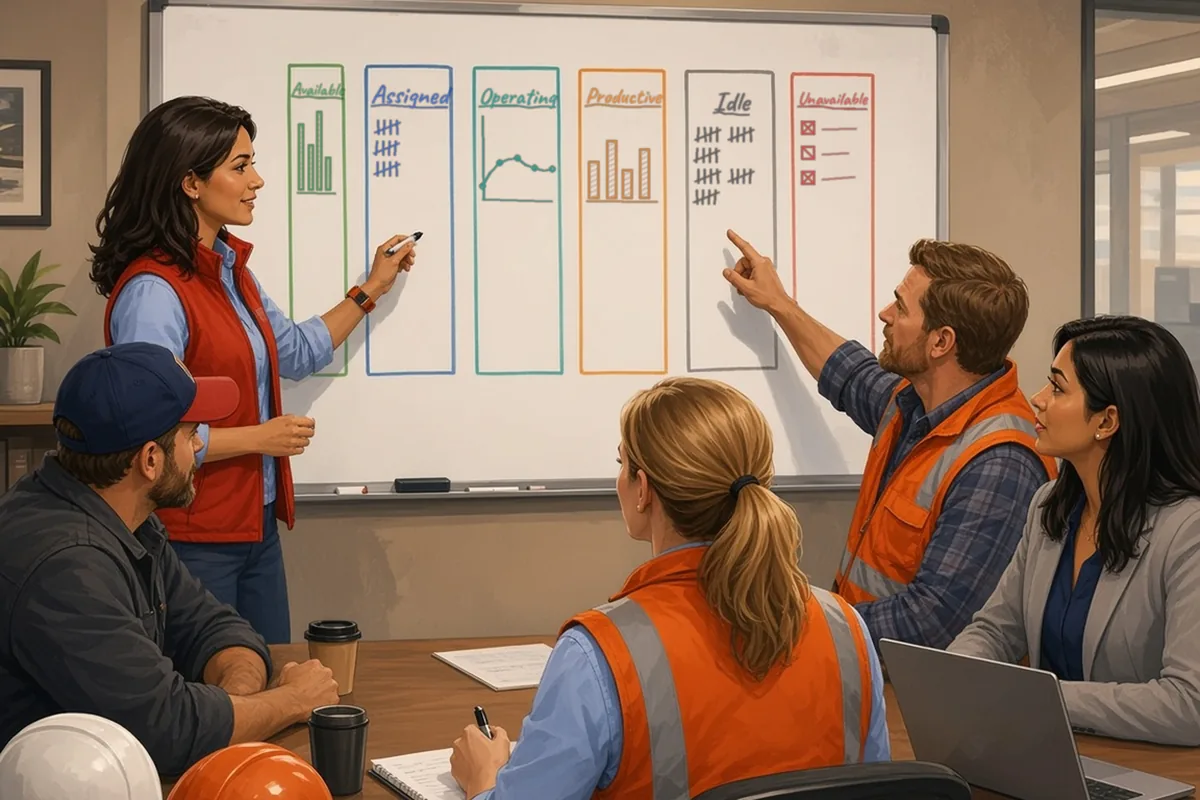
That one move changed the conversation. A machine assigned to a job but barely used no longer looked productive. A machine held in the workshop no longer poisoned the denominator as if it had been freely available. A unit with high engine-on time but weak productive output could be flagged for idle analysis instead of being blindly praised as “well utilized.”
RedClay also introduced exception flags instead of relying on averages alone: assigned but unused, high idle ratio, unavailable too long, movement without valid assignment, repeated workshop-held units counted as available, and operating activity with no project context.
Ownership was clarified as well. Fleet owned the metric design. Finance owned decision-use. Operations owned assignment reality. Workshop owned downtime validation. Field owned readiness truth. No haunted KPIs drifting through slide decks like corporate ghosts.
Downloadable template: Utilization Logic Reset
Use this worksheet to reset utilization logic before the next review cycle.
| Field | What to capture | Why it matters |
|---|---|---|
| Asset ID | Unique machine identifier | Stops asset-level confusion |
| Branch | Home branch or current location | Shows local demand context |
| Project / Assignment | Assigned job or crew | Separates booked from actually used |
| Available Hours | Hours machine could reasonably work | Controls the denominator |
| Assigned Hours | Hours allocated to operations | Shows planning demand |
| Operating Hours | Engine-on or measured active time | Captures raw activity |
| Productive Hours | Best estimate of real working time | Avoids over-crediting runtime |
| Idle Hours | Powered but not productive | Exposes waste masked as use |
| Unavailable Hours | Service, damage, inspection, or transport hold | Prevents false availability |
| Exception Flag | Assigned-not-used, high idle, unavailable too long, no project context | Turns data into action |
| Owner | Fleet, Ops, Workshop, Field, Finance | Makes validation explicit |
| Action Required | Review, redeploy, repair, monitor, reclassify | Forces closure |
Recommended fix workflow
- Define utilization-related terms in writing before building reports.
- Separate assignment rate, operating rate, and productive rate.
- Remove governed downtime from available-hours logic.
- Create exception rules instead of relying on summary averages.
- Assign one owner per exception type.
- Review disputed assets at machine level, not dashboard level.
- Use the output for decisions only after the definition stays stable for at least one review cycle.
Download the Utilization Logic Reset Template
What to look for in software
For this problem, RedClay would care about mixed-fleet data normalization, configurable utilization logic, downtime categorization, exception flagging, exportable raw data, and role-based validation workflow. The point is not to worship feature lists like sacred relics. The point is to support the operating model instead of adding another polished layer of reporting theater.
One-line practical takeaway
If you blend assignment, activity, productivity, and downtime into one utilization number, the dashboard is not helping you think — it is dressing confusion in business casual.